
Writerly Wednesday
A sneak peek

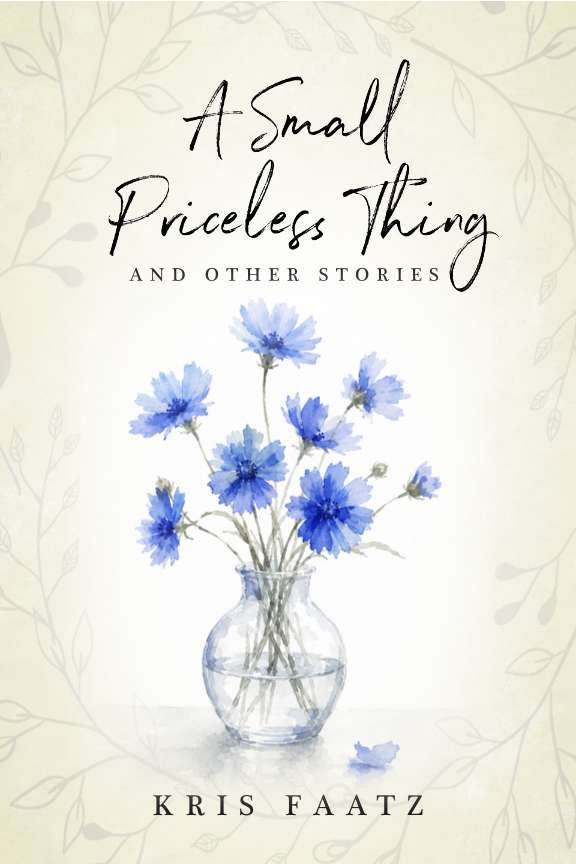
A story for your Wednesday, and a sneak peek of the cover of my collection A Small Priceless Thing and Other Stories, forthcoming in March 2027 from Highlander Press.
I’m thrilled to share this cover. Highlander’s artist Pat Creedon, who also created the art for my novels Line Magic and Fourteen Stones, did a beautiful job. The collection includes several “flower stories,” with titles and storylines relating to different flowers, and we wanted to use that idea on the cover. I also loved the idea of a small fallen petal, to emphasize how priceless things can be found everywhere.
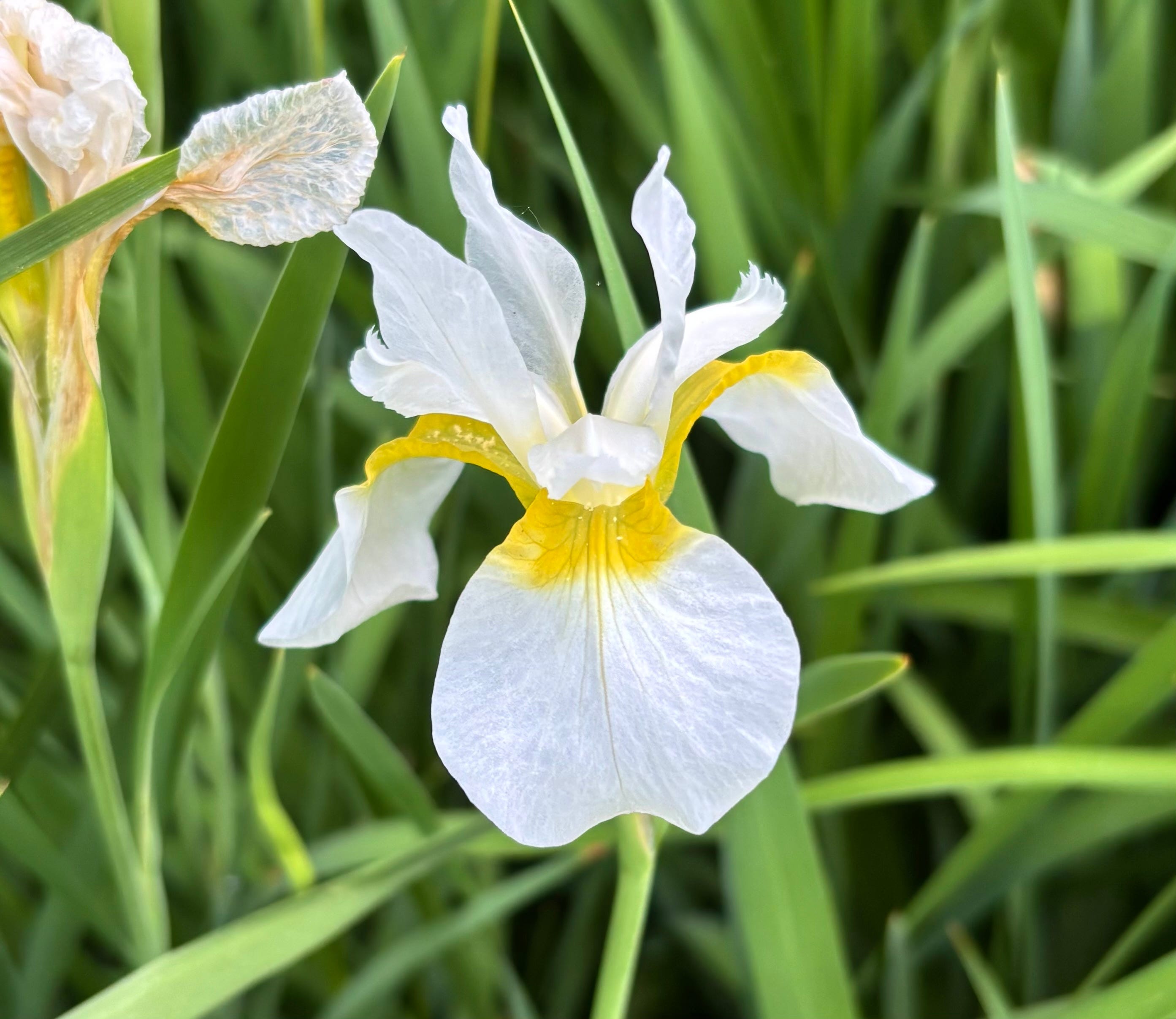
One of the collection’s flower stories is “Iris,” which I wrote a few years ago and which was published in Tiferet Journal as the winner of their 2020 short fiction prize. The iris is one of my favorite flowers, for its striking grace and for its impermanence, blooming for a day and then fading. This story, with its blend of fantasy and reality, was a joy to write.
“Iris” is offered here as a sneak peek at the collection’s flower pieces. Please have a look, and please stay tuned for more updates on the collection!
**
IRIS
My father says the surgery will ruin his hands. He says he won’t be able to make the flowers anymore: his body won’t want the new joints, he’ll never get his muscle tone back. He won’t have the control that lets him put each perfect crimp and twist in the bright-colored paper so that the magic happens. Over the years that he’s neglected the arthritis, his thumbs have gotten so stiff that he can’t button his own shirts or pick up a glass, but he still won’t let the doctors help him.
That’s why he needs me. I spend every day at his house, thirty miles away from my apartment in the city. I bring him sandwiches, wash his clothes, put straws in his iced hibiscus tea.
The flowers are his life. They matter more than everything else.
I’m twenty-three. My father’s life has always defined mine. His business – Thomas Glescot, Florist – is forty years old. I can’t take it over from him, because I don’t have his gift, so he says he can’t retire. Neither can I. I have to hold the rest of his life together so he can make the flowers that make him famous.
Sometimes I imagine the doctors opening my father’s hands. A scalpel incising the skin to lay the knuckles bare. Forceps lifting out the ruined joints and sliding in the black pyrocarbon. I imagine that there’s no recovery time. The doctors finish, my father opens his eyes, and his hands are a young man’s again.
And I’m free.
Sometimes I look at myself in the mirror to remember I’m a person with a body, not a flat shadow joined to my father’s feet. Sometimes I talk to myself out loud, to remember I have a voice.
**
When I was a little girl, I thought the flowers were a game. In my first memories, I’m sitting on my father’s lap. He’s showing me how to make a rose: petals folded from pink tissue, a deep green stem rolled tight, paler green leaves. Even tiny cones for thorns. He shows me each of these things, step by step, letting me try with my small clumsy fingers and fixing my mistakes.
The finished rose looks so real that I put my nose in it to sniff. My father laughs. “Not yet.”
He opens the door of the tall wooden cabinet in his workroom. Inside, paper flowers of all kinds sit in small glass vases. This is his garden.
“We put it in here,” he says. He puts the rose in its own vase and closes the cabinet door. “Then it’ll grow.”
The next morning, he opens the cabinet. I smell the rose before I see it. He takes it out and I run a finger along its living petals, touch the point of a sharp thorn.
I don’t remember my mother, but she must have been quiet, like me. My father decided when to have a child, decided to name me Iris after his favorite flower. While she lived, my mother went quietly along with everything. She probably hoped I would grow up with his magic and certainty.
I didn’t. He wanted me to learn the magic, but however many flowers I made for him, crumpling and tearing a rainbow of tissue, I never got them right. For the magic to work, the flowers must be perfect in every detail. Morning after morning, I opened the cabinet to find his living blooms next to my paper mistakes.
My father makes every kind of flower you can imagine. Roses, lilies, hyacinth and hydrangea, Birds of Paradise, starry alstromeria, gracious orchid.
Every kind except an iris.
**
Yesterday, my father went to the hand surgeon in the city. I took him, because his hands don’t let him drive.
The surgeon, Dr. Kane, has met with us many times already. This time, he laid things out flat.
“Mr. Glescot, you’re running out of time.”
Our last name is actually Glasscourt. We have an ancestor who, as my father puts it, “wasn’t entirely human,” who left us an otherworldly name and the gift with flowers. I inherited one of those things.
Dr. Kane said, “The recovery only gets harder the longer you wait. The muscles don’t respond to therapy as fast.” He flexed his own hands, where age spots were starting to show. “I’m younger than you and I’d have trouble. Pretty soon, you won’t be able to use your hands at all.”
My father said, “I can still work.”
Dr. Kane looked at me. “You can work if your daughter does everything else for you. Is that fair to her?”
I don’t ask questions like that, but the doctor’s words caught like a hook in my stomach. Fair? I don’t have a job or life of my own. My father pays me to be his shadow.
My father said, “She’s glad to help. She’ll have time to do what she wants when I’m gone.”
When he’s gone, I’ll be lost. I’ve never known how to want anything.
Dr. Kane said, “Mr. Glescot, I understand you care about your work. Your flowers are extraordinary.” They are. Each one is a perfect specimen. They last for weeks before they fade, even the kinds that usually bloom and wilt in a day. “But,” Dr. Kane said, “you have to realize that the risks involved in not doing the surgery far outweigh the…”
My father cut him off. “The risks involved in doing it?” His voice was sharp. “You have to realize that I can’t take any risks. I won’t take any risks while I can still work.”
“But your hands – ”
“If my hands give out, they give out. I won’t let you cut them up so it happens sooner.”
I kept my face still. If his hands give out and even surgery can’t help him, what will that mean for him? For me?
No one can argue with my father when he’s made up his mind. We left Dr. Kane’s office. When we got back to the house, my father shut himself in his workroom alone. He was still in there three hours later, when I called through the door to tell him I was leaving for the night.
**
This morning, when I get to my father’s house, I find his workroom door still closed. Normally he’s waiting at the kitchen table in his bathrobe and pajamas, so I can help him with his clothes and fix breakfast for us both.
I knock on the workroom door. “Dad?”
Last night, he only called “Good night” back to me when I told him I was leaving. This morning, I hear, “Don’t come in.”
His voice sounds thick. Tired? Upset? Drunk? He wouldn’t have had a drink when I wasn’t here to uncork the wine bottle. Anger runs up my spine. He could have managed “Good morning.”
I leave the workroom door shut and go to the kitchen. His kitchen is much nicer than mine: new appliances, smooth wooden cabinets, and most of all, counter space. My apartment has a galley that I can barely turn around in, but I don’t use it much anyway.
Every morning my father and I have bacon sandwiches on rye toast, with half a grapefruit each. I fry the bacon on the stove, thinking its smell will bring him out of the workroom.
It doesn’t. I fix the sandwich, sugar the grapefruit, and carry the plate to his door.
“Dad?” I knock again, louder this time. “Breakfast.”
No answer. I can hear what sounds like paper crinkling, and my father’s voice muttering. He’s always been obsessed with his work, but not like this.
His sandwich is getting cold. So is mine, back in the kitchen. “Dad,” I call again. “Come and eat.”
“Leave me alone, Iris.”
For one heartbeat, I think about winging his plate down the hallway to shatter against the far wall. I don’t do things like that. Instead I carefully set the plate down on the floor in front of his door. Then I go back to the kitchen and eat my breakfast alone.
The workroom doesn’t open by the time I clean up the kitchen, or finish a load of laundry, or make tuna salad for lunch. My father’s bacon sandwich is cold, two pieces of flabby toast with a slab of congealed grease between them.
I knock. “Dad. Are you all right?”
No answer. No sound from the other side of the door.
Again, for a heartbeat, I imagine doing something I never would. Leaving the house, getting into my car, driving away and not coming back.
Instead I try the workroom door handle. It’s unlocked. The door swings open.
My father is sitting at the big wooden worktable where he makes the flowers. He’s still in his clothes from yesterday. Scraps of white and green and purple paper litter the floor around him.
He has his back to me, his head down in his stiff hands. His desk lamp is on, the bulb bright behind the magnifying lens. In the light, his hair is perfectly white.
“Dad?”
He doesn’t answer. I come into the room. Now I can see the scraps of paper more clearly. He’s been trying to make something, trying and failing again and again.
I pick up what looks like a flower that he finished and then crumpled and threw away, the same way I used to wad up my failures. I smooth out the petals. At first, I don’t realize what I’m looking at.
My father speaks without raising his head or turning around. “I can’t do it. You don’t know how many times I’ve tried.”
Then I see it. The flower in my hands is an iris. A white iris with purple flames at its throat.
My father says, “I’ve tried every day since you were born.”
I go over to the table, my body strangely light, my throat tight. When I put my hand on his shoulder, he looks up. Tears stand in his dark eyes. I’ve never seen him cry before.
“Any other kind, I can do,” he says. “Any kind at all. But these are never good enough.” The flowers have to be perfect in every detail. “I don’t know why. The only one that matters, and I can’t do it.”
I look around at all the times he’s tried since last night alone. I never saw any of his failures in the cabinet. He must have tucked them in the back, out of sight, afraid of what he’d find when he opened the door. The same way I was afraid to look at my own failures.
He says, “I can’t let them operate on my hands, Iris. In case I don’t heal. I can’t let them do it until…”
He doesn’t finish, but I understand. Until he does this one thing.
I set the paper flower gently down on the desk. “Can I help?”
After lunch, we work through the afternoon. Cutting, folding, rolling, joining the flower petals and stems with tiny drops of glue. His hands can’t control the scissors as well as mine can. I can’t fold the paper as perfectly as he does. We finish a flower, study it from every angle, shake our heads and try again.
Finally, at the end of the day, we have a single specimen. The purple-throated white iris looks so real I can’t help holding it up to my face, expecting to catch its faint, sweet scent.
My father laughs. “Not yet.”
We put it in the cabinet. Our eyes meet as we shut the door.
Tomorrow, on the shelf, we’ll find a single proud white iris. Its living petals will feel as soft and smooth as a baby’s skin. My father will see the one thing he always wanted to do: the only thing that mattered.
Then he and I can both be free.
**
Thanks so much for reading. Take care,
Kris
About A Place to Stand:
I started this column in hopes of creating a bit of space and sharing light in challenging times, by offering meditative creative prompts and selections of my own work as a writer and musician.
You can find out more about me and my work at my website. If you enjoy what you’ve read here, please consider subscribing and/or sharing this post. Thank you!
What a beautiful and loving father-daughter story.
And I love the magic the father has in turning paper flowers into real ones.
So beautiful and reminiscent of Line Magic:)
What memories this story evokes for me. My mother had a cottage business in the late 1960s making flowers from tissue paper, with stems of wrapped florist tape. We rolled tissue petals on pencils and then scrunched the paper into bloom shapes. We assembled the petals into all sorts of blooms--flowers that wouldn't grow in the Arizona heat. One Christmas, Mom was discouraged so she wrapped all the gifts in tissue paper but then our Siamese cat knocked over the water at the tree's base and those wrappings bled all over the carpet. The flowers would have done better if they had that cabinet. Well done! ~Linda Clare at The Deep End